
Transformer size is the decision that quietly governs a low voltage landscape lighting project in Northampton, PA, and it is usually the last thing on the shopping list. Homeowners and contractors arrive with a fixture count and a style preference. What determines how well the finished system performs is the relationship between total wattage, cable length and the unit powering it.
Valley Stone Supply brings over three decades of industry experience to the counter and stocks low voltage landscape lighting fixtures and components for pathways, patios, and accent lighting. We focus on materials, fabrication and delivery rather than on-site installation, so this is written for the person standing at the counter putting together a materials list, or for the contractor pricing a job before the crew is booked.
Lighting is also the one element on most hardscape projects that gets priced last and specified fastest, which is why so many materials lists arrive at the counter with a fixture count and no cable figure attached to it.
The sections below are the questions our yard team works through most often with customers buying lighting for a Lehigh Valley property.
What Does Low Voltage Actually Mean in a Landscape Lighting System?
A low voltage system runs at 12 volts rather than household line voltage. A transformer sits between the two, taking the supply down to a level that is far safer to work around and that permits shallower cable burial than line-voltage work requires.
That is the practical appeal. Cable runs through planting beds and along hardscape edges without the conduit depth and the trade involvement a 120-volt circuit demands, which puts a considerable share of landscape lighting within reach of a general hardscape crew.
The tradeoff is voltage drop. Twelve volts has very little margin, so losses along a long cable run that would be irrelevant at line voltage are enough here to visibly dim the fixtures at the far end. Nearly every design rule that follows exists because of that one characteristic.
How Is a Landscape Lighting Transformer Sized?
A landscape lighting transformer is sized by adding the wattage of every fixture it will carry, then choosing a unit comfortably above that figure. Loading to roughly 80 percent of the rating is the common working practice, leaving both an operating margin and room for the fixtures somebody adds in a later season.
LED fixtures have made this easier and introduced a different trap. A modern path light draws around three watts where its halogen predecessor drew twenty, so a count of fixtures no longer tells anyone anything useful about load. The wattage figures have to be read off the actual products on the list.
Multi-tap transformers are worth understanding before purchase. They offer output terminals at several voltages above 12, which gives a way to compensate for the losses on a long run by feeding it at a slightly higher voltage.
A single-tap unit removes that adjustment from the project permanently.
Why Does Wire Gauge Decide How Far a Lighting Run Can Go?
Wire gauge decides how far a lighting run can go because thicker cable carries current with less loss. On a 12-volt system that translates directly into how far a run reaches before the fixtures at the end are visibly dimmer than the ones nearest the transformer.
Most landscape work uses 12, 14 or 16 gauge, and the smaller number is the thicker cable. A short run of a handful of low-wattage LED path lights behaves acceptably on light cable, and the same cable serving a long run of uplights across a property performs poorly at the far end.
Layout changes the arithmetic as much as gauge does. Running a single cable out and back in a loop, or splitting the property into several shorter runs leaving the transformer in different directions, both shorten the worst-case distance. Those decisions belong on the plan rather than in the garden at dusk.
Which Landscape Lighting Fixture Types Do Which Jobs?
Path lights mark routes, uplights and well lights pick out a subject, and hardscape and step lights build the lighting into the structure itself.
Path lights mark a route and a change in level, and they are the fitting most often over-specified, because a line of them at even intervals down a straight walk produces the runway effect rather than the pool of light each one was bought for.
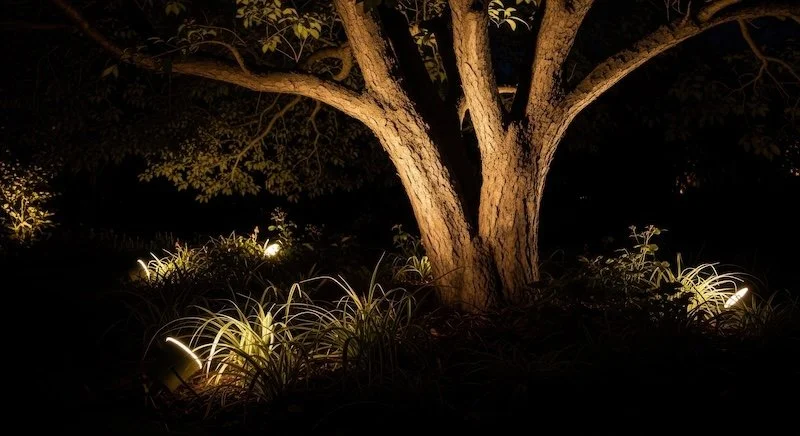
Uplights point at a subject: a tree trunk, a stone facade, a specimen shrub. Well lights do the same work set flush into the ground where a visible fitting would be in the way, which suits a paved area or a tight bed against a wall.
Hardscape and step lights are a different category because they are built into the structure. A fitting recessed under a wall cap washing the course below it, or set into a riser to show the edge of a tread, disappears completely in daylight and does the most useful safety work after dark.
What Lighting Has to Be Planned While a Wall or Step Is Being Built?
Anything recessed into stone has to be placed as the stone goes down. The fitting, the void it sits in and the cable route reaching it are set during the build, and the course above closes over the installation.
That makes the lighting list part of the masonry order rather than a later purchase. A customer buying wall block, caps and step treads from our yard is better served adding the hardscape fittings to the same order than returning in spring to ask what can be retrofitted.
The same applies to anything crossing under a surface. A sleeve laid beneath a walk or a patio while the base is open costs almost nothing, and reaching the far side of a finished surface later means cutting it or routing the long way around.
How Do Lehigh Valley Winters Affect Lighting Fixtures and Connections?
Lehigh Valley winters break down wire connections well before they damage fixtures. Repeated freezing and thawing works moisture into any joint that was not made properly, and a corroded connection shows up as a fixture that flickers or goes dark while everything else on the run is fine.
Waterproof connectors are therefore a material decision rather than an accessory. Gel-filled and heat-shrink types both exist for the purpose, and the twist-on connectors sold for indoor work are the single most common cause of a system that performs well in its first autumn and poorly in its second.
Fixture housing matters on the same timescale. Cast brass and copper weather to a patina and keep working, solid aluminum performs well when the finish is intact, and thin plastic housings tend to become brittle after a few eastern Pennsylvania winters.
What Should Be on a Landscape Lighting Materials List Before Ordering?
A complete list names the fixture types and their quantities, the connected wattage, the transformer size and tap arrangement, the cable gauge and total footage, the connectors, and any sleeves needed for crossings.
Mounting hardware is the item most often forgotten. Tree-mount brackets, wall plates and the stakes suited to heavier soil are small components that stop a project at the end of the day when they turn out not to be in the van.
Ordering a small surplus of cable and connectors is sensible rather than wasteful. Runs rarely measure out exactly as drawn once beds and obstacles are accounted for, and a second trip to the yard costs more than the spare material does.
How Are Landscape Lighting Controls and Switching Handled?
Most landscape lighting systems run on a photocell, a timer, or both together. A photocell brings the lighting on at dusk without seasonal adjustment, and a timer sets the hour it goes off, which matters on a property where nobody wants the uplighting running until dawn.
Splitting the property across more than one transformer gives separate control as a by-product. A front entrance that runs every night and rear garden lighting used on occasions then operate on different schedules rather than sharing one.
Smart controllers add scheduling and remote operation and ask for a reliable wireless signal at the transformer location, which is worth checking before purchase on a detached garage or a far corner of a property.
How Does Landscape Lighting Interact With Stone Surfaces?
Color temperature and beam angle decide how stone reads after dark. A warm output around 2700 kelvin keeps the tones in brick, buff sandstone and limestone close to how they appear in daylight, while a cooler output pushes the same surfaces toward gray and flattens them.
Beam angle does the rest. A narrow beam aimed up a stone face picks out depth and shadow in the coursing, and a wide wash across the same wall removes that relief and leaves it looking like a flat panel.
Texture is the deciding factor. Irregular fieldstone, split-face veneer and tumbled block all reward a fitting mounted close to the surface and aimed steeply along it, which is why grazing positions get marked on the wall before any fitting is bought.
What Does a Contractor Need From a Lighting Supplier That a Homeowner Does Not?
Contractors need quantity consistency and dependable lead times more than a homeowner does. A crew buying fittings for several properties wants the same housing finish and the same lamp output across the job, and mixing production runs shows up as a visible difference in color on adjacent fixtures.
Lead time is the other. A homeowner can wait a week for a part and a crew booked on a property cannot, which is why calling the yard ahead with a list gets material staged before the trailer arrives rather than assembled at the counter.
Contractors also tend to buy cable in longer lengths and connectors in volume, because the per-unit arithmetic changes sharply above a certain quantity and because running short on a job site costs more than the surplus does.
What Goes Wrong Most Often on a Lighting Materials List?
Underspecified cable is the most common error we see corrected at the counter. A gauge chosen for cost on a run that turns out to be ninety feet produces fixtures that are visibly dim at the end, and the cable is buried by the time anyone notices.
A transformer loaded to its rating is the second. It works on the day it is commissioned and leaves no capacity for the two fittings somebody adds the following spring, which means buying a second transformer rather than extending the first.
The third is buying fittings before settling the layout. Fixture type follows what each position has to do, and a box of path lights bought on appearance rarely matches the mix of uplights, well lights and hardscape fittings the plan actually calls for.
What Does Keeping a Landscape Lighting System Working Involve?
Keeping a landscape lighting system working mostly means resetting aim, cleaning lenses and moving fixtures as the planting grows.
Ground around a stake settles through a wet spring, a mower clips a fitting, and the uplight that was grazing a stone face in October is lighting the gutter by April. Walking the property after dark once a season and resetting the aim is most of the work.
Lenses and housings collect what the garden produces. Soil splash, mulch dust and leaf debris cut output noticeably on a ground-level fitting, and a wipe with a damp cloth restores more brightness than people expect.
Growth is the longer-term factor. A fixture placed to wash a young shrub ends up buried inside it after three seasons, so the plan a property starts with is reviewed against what has grown rather than treated as permanent. Customers often come back to the yard for a handful of relocation stakes and a length of cable rather than for a new system.
Spec Your Low Voltage Landscape Lighting at Our Northampton, PA Yard
A lighting project succeeds or fails on three numbers settled before anything is bought: connected wattage, run length and cable gauge. Bring your plan and your fixture count to the counter and the yard team will work the list through with you.
Valley Stone Supply carries landscape lighting fixtures and components alongside the natural stone, veneer, block and bulk materials we supply to contractors and homeowners throughout Northampton and the Lehigh Valley, with brands including Unilock, Techo-Bloc, Cambridge Pavingstones and ProVia.
Request a landscape lighting materials quote from Valley Stone Supply before your next project starts.
In Summary
How many fixtures can one transformer carry?
One transformer carries as many fixtures as its rated wattage allows once the common 80 percent loading rule is applied. Loading a transformer to around 80 percent of its rating leaves headroom for a future addition and keeps the unit from running at its limit. Count the connected wattage of every fixture on the run before choosing the size, because fixture count alone says little about load with LED products.
Can hardscape lights be added to a wall that is already built?
Surface-mounted fittings retrofit onto a finished wall, while recessed hardscape and step lights generally cannot go in without taking courses apart. Anything meant to disappear into the stone has to be planned while the wall is being laid, which is why Valley Stone Supply puts the lighting list on the materials order alongside the block.
Does low voltage wiring need to be buried deep?
Low voltage cable sits far shallower than line-voltage work, and the practical depth is governed by what will dig, edge or aerate above it rather than by code alone. Running cable along bed edges and under mulch, with the route recorded, keeps it clear of a spade in a future season.
What should be bought first on a lighting project?
The fixture list and the layout come first on a lighting project, because together they give the connected wattage that sizes the transformer and the run lengths that set the wire gauge. Buying the transformer first commits the project to a capacity before anyone knows what it has to carry.
Related: Materials for Retaining Walls in Northampton, PA: Block, Natural Stone and Boulders Compared